Description
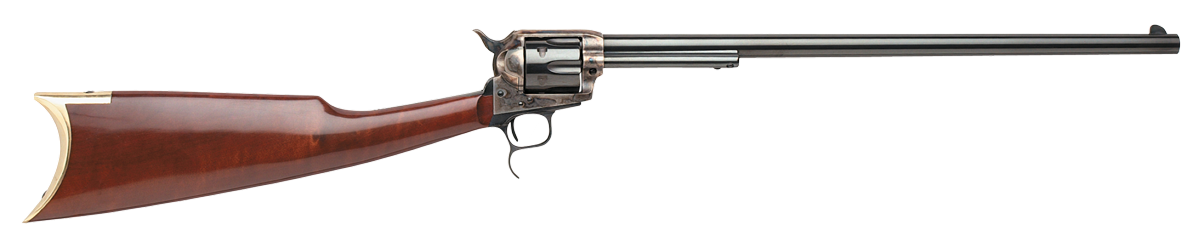
Revolving carbines never got the fame that lever guns did, but they were real working firearms carried through several major conflicts of the 1800s. Taylor's & Company brings that overlooked chapter back to life with the 1873 Cattleman Revolving Carbine. The recipe is straightforward: take the time-tested Cattleman single-action platform, stretch the barrel to 18 inches, and fit a proper walnut buttstock so it shoulders like a rifle. The result is one of the most conversation-starting firearms you can bring to the range, and it runs exactly like the Cattleman revolvers people have trusted for decades.
What Makes the Cattleman Revolving Carbine Different
This carbine is built on the new model forged frame, and the trigger guard carries a spur along the bottom edge that gives your support hand a natural anchor point. That detail matters more than it sounds, because it lets you settle in comfortably and keep everything steady from cylinder to muzzle. At 4.4 pounds and 35 inches overall, it carries easier than most lever guns and points fast. The blued 18 inch barrel uses a 1 in 36 twist that suits the .44-40 well, and the fixed blade front and notch rear sights keep the sight picture period correct and fuss free.
A .44-40 Carbine With Real History Behind It
The .44-40 Winchester chambering is the right call here. It was the cartridge of 1873, ran in rifles and revolvers alike back in the day, and it remains a favorite among cowboy action competitors for its mild recoil and pleasant shooting manners. Out of an 18 inch barrel you pick up a nice bump in velocity over a revolver too. Cocking the big single-action hammer, thumbing rounds through the loading gate, and hearing that four click cycle from the shoulder is an experience all its own.
Built by Uberti in Italy and imported by Taylor's & Company, the fit and finish live up to the reputation, with rich walnut set against deep bluing. Whether it ends up in a Western collection, at cowboy matches, or just out on the range turning heads, this one earns its spot.
Key Specifications
- Manufacturer: Taylor's & Company (made by Uberti)
- Manufacturer Part Number: 550128
- UPC: 839665005644
- Caliber: .44-40 Winchester
- Action: Single Action
- Capacity: 6 rounds
- Barrel Length: 18 inches
- Twist Rate: 1:36"
- Overall Length: 35 inches
- Weight: 4.4 lbs
- Frame: New model forged steel, blued
- Stock: Walnut buttstock
- Sights: Fixed blade front, notch rear
- Trigger Guard: Spurred for support-hand grip
- ATF Classification: Rifle
What’s Included
- Taylor's & Co 1873 Cattleman Revolving Carbine
- Owner's manual
- Manufacturer's box
Frequently Asked Questions
Who makes the 1873 Cattleman Revolving Carbine?
It's manufactured by Uberti in Italy and imported by Taylor's & Company out of Virginia. Uberti has been building faithful reproductions of classic American firearms for decades, and the fit and finish on their Cattleman line reflects that experience. Taylor's handles the importing, spec selection, and support on this side of the pond.
Where should I place my support hand when shooting a revolving carbine?
Keep your support hand behind the cylinder, and the spurred trigger guard on this model gives you a natural spot to anchor it. Like any revolver, there's a small gap between the cylinder and barrel where gas escapes on firing, so you never want fingers forward of that point. Once you settle into the grip it feels steady and balances nicely.
Is the Cattleman Revolving Carbine good for cowboy action shooting?
It's a great fit for the cowboy action world, and .44-40 Winchester is one of the most popular cartridges in that game. Recoil is mild, the single-action manual of arms is the same as a Cattleman revolver, and the 18 inch barrel wrings a little extra velocity out of the round. It also makes a fun, easy-handling range gun at just 4.4 pounds.
How do you load and operate this carbine?
It runs exactly like a classic single-action revolver, just with a buttstock. Rounds load one at a time through the loading gate on the right side of the frame, and the hammer must be cocked manually for each shot. Empties are pushed out with the ejector rod alongside the barrel.




Reviews
There are no reviews yet.