Description
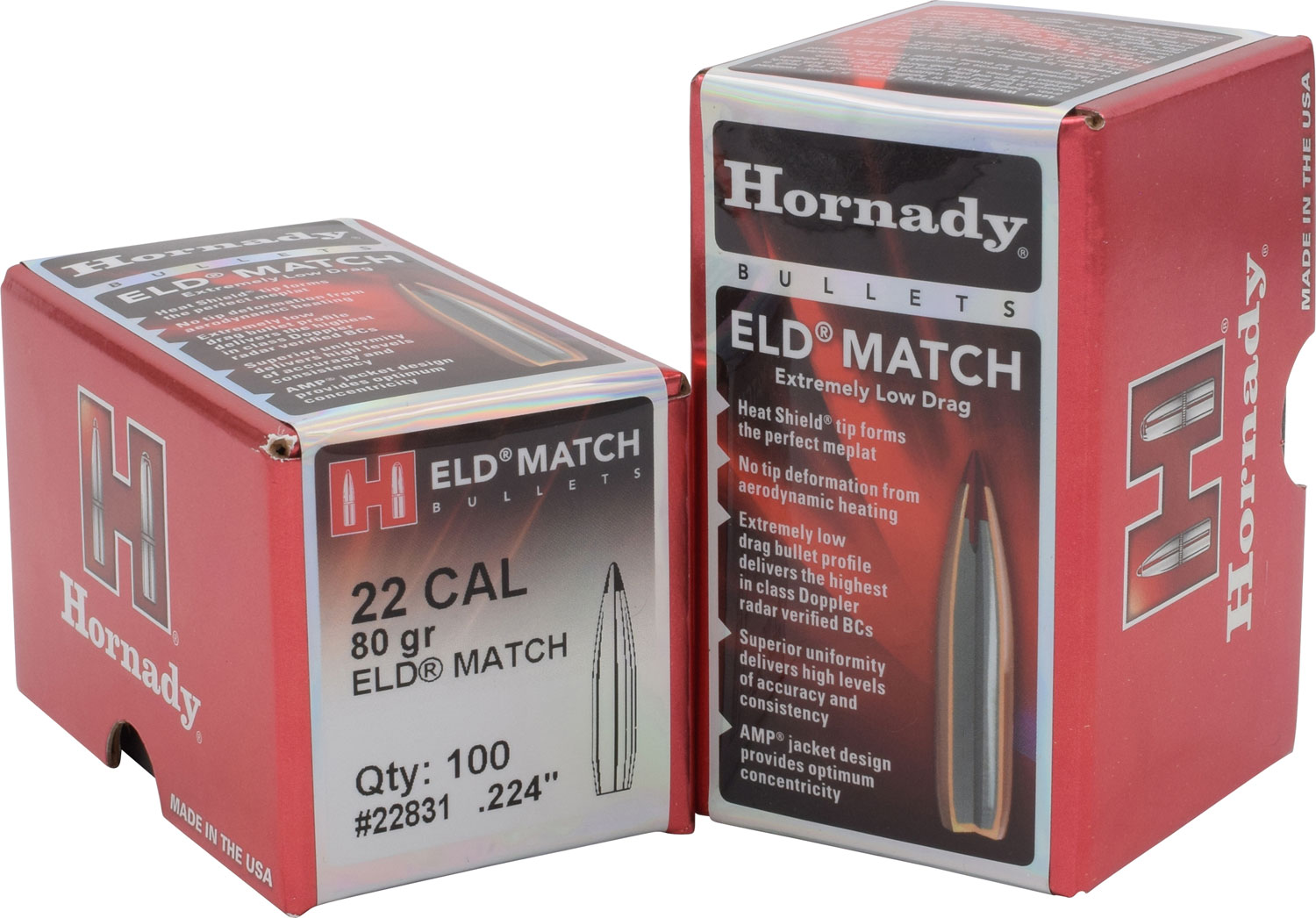
The Hornady ELD Match 22 Cal .224 80gr bullet is a component projectile built for handloaders who chase small groups and care about what their loads do past 500 yards. It carries a G1 ballistic coefficient of .485 and a G7 of .244, with a sectional density of .228, which adds up to a bullet that holds velocity and fights wind drift better than most .224 offerings in its weight class. It is a target and match projectile, not loaded ammunition, so this is the bullet only for your own reloading.
What Sets the 80gr ELD Match Apart
The heart of this bullet is the Heat Shield tip. Traditional polymer tips can soften and deform from aerodynamic heating in flight, which throws off the meplat and hurts downrange consistency. Hornady's Heat Shield material resists that heating and keeps the tip shape uniform, so the bullet flies the same way every time. Pair that with a streamlined secant ogive, an optimized boattail, and highly concentric AMP jackets, and you get a projectile engineered for best-in-class BC and bullet-to-bullet repeatability.
Chamberings and Twist for the .224 80gr ELD Match
Hornady lists a 1-8 inch twist as the minimum recommended for this bullet, and that matters. At 80 grains with a long jacket, this projectile needs enough spin to stabilize properly, so a 1-8 or faster barrel is the way to go. Reloaders run it in everything from .223 Wylde and 5.56 to .224 Valkyrie, .22 Creedmoor, .22-250, and the .22 ARC. Feedback from folks loading it is consistently strong, with many reporting quarter-inch to half-inch groups at 100 yards once they dial in a load, and good manners well past that.
Doppler-Verified Consistency
The BCs on these bullets aren't guesswork. Hornady measures them with Doppler radar and corrects to standard atmospheric conditions, so the numbers you plug into your ballistic app reflect real-world flight. Made in the USA, this box gives serious handloaders a proven match bullet to build precision loads around.
Key Specifications
- Manufacturer: Hornady
- Manufacturer Part Number: 22831
- UPC: 090255228311
- Bullet Caliber: .22 Caliber (.224 diameter)
- Bullet Diameter: .224 inch
- Weight: 80 Grain
- Bullet Type: ELD Match (Extremely Low Drag Match)
- Bullet Shape: Secant Ogive Boattail
- Tip Material: Heat Shield Polymer
- Jacket Material: AMP (copper)
- Core Material: Lead
- Cannelure: No
- G1 Ballistic Coefficient: .485
- G7 Ballistic Coefficient: .244
- Sectional Density: .228
- Minimum Recommended Twist: 1-8 inch
- Quantity: 100 Per Box
- Recommended Usage: Target / Match
- Country of Origin: USA
What’s Included
- 100 Hornady 80gr ELD Match .224 caliber bullets (component projectiles, not loaded ammunition)
Frequently Asked Questions
Are these Hornady ELD Match 80gr loaded cartridges or just bullets?
These are component projectiles for reloading, not loaded ammunition. You supply your own brass, powder, and primers to assemble finished rounds. The box contains 100 bullets ready for your handloading bench.
What barrel twist do I need to stabilize the 80gr ELD Match?
Hornady lists a 1-8 inch twist as the minimum recommended for this bullet. Because the 80-grain projectile is long with an extended jacket, a slower twist like 1-9 may not stabilize it well. A 1-8 or faster barrel is the safe bet for consistent accuracy.
Which cartridges work well with the .224 80gr ELD Match?
Reloaders run this bullet across a range of .224 chamberings including .223 Wylde, 5.56, .224 Valkyrie, .22-250, .22 ARC, and .22 Creedmoor, as long as the barrel twist is fast enough to stabilize it. It's a popular choice for long-range and match-oriented builds. Always consult current published load data and start low when working up a load.
What makes the Heat Shield tip different from a standard polymer tip?
Standard polymer tips can deform from aerodynamic heating during flight, which changes the bullet's meplat and hurts consistency. The Heat Shield tip resists that heating and holds its shape, keeping the tip profile uniform from shot to shot. That consistency is a big part of why these bullets deliver high, repeatable ballistic coefficients.





Reviews
There are no reviews yet.