Description
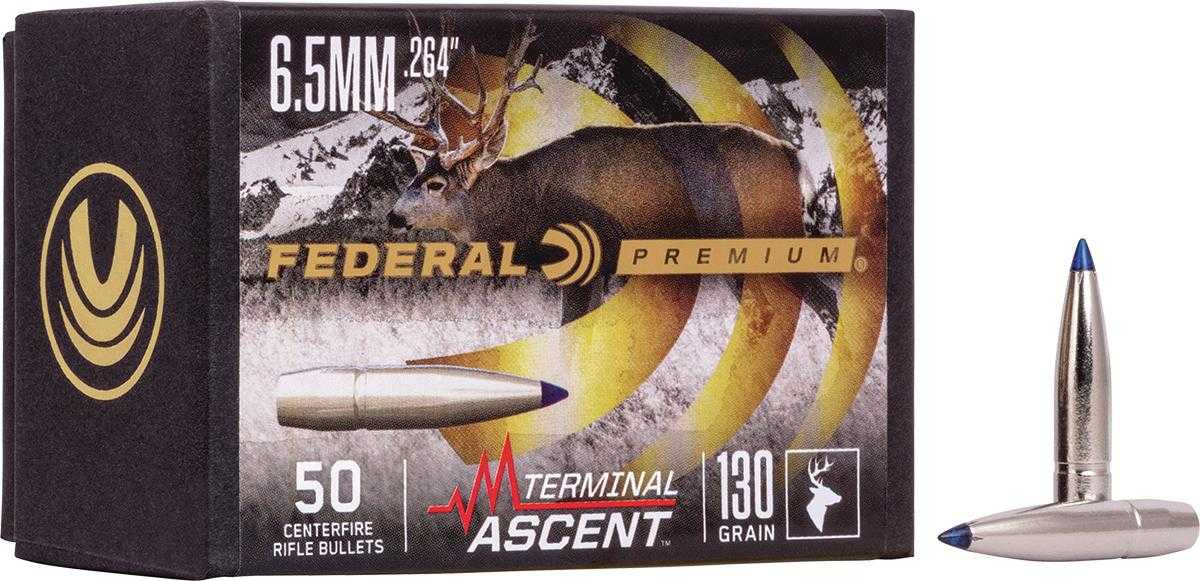
The Federal Terminal Ascent component bullet in .264 diameter, 130 grain gives handloaders a projectile that blurs the line between a match bullet and a big game bullet. Built around a solid copper shank and a bonded lead core, it holds its weight together for deep, straight penetration while still opening up when it counts. With a G1 ballistic coefficient of .532 (.263 G7), this one bucks the wind and holds its line at distance, which is exactly what you want out of a 6.5 Creedmoor, 6.5 PRC, or 264 Win Mag.
What Makes the Terminal Ascent Bullet Tick
The headline feature is the patented Slipstream polymer tip, which uses a hollow-core design to start expansion at velocities as low as around 1,400 fps. That matters because a bullet fired at a deer 500-plus yards out has shed a lot of speed by the time it arrives, and this one still opens reliably at those slower impact numbers. Up close, the bonded construction keeps things together so you punch through hide and bone without coming apart.
Loading and Accuracy Notes for the .264 130 Grain
The AccuChannel groove technology is Federal's answer to the accuracy grooves you see on solid-copper designs, but shaped to add only minimal drag. Two grooves along the shank help it settle down across a range of rifles while cutting fouling and barrel wear. Reloaders running the 6.5 Creedmoor have reported real-world velocities in the 2,730 to 2,800 fps range depending on barrel length, and Federal's own data shows powders like Reloder 26, Reloder 16, and Power Pro 2000-MR all playing well with this bullet at a 2.800 inch OAL.
Field feedback backs up the accuracy reputation. Hunters loading this bullet for 6.5 Creedmoor and 6.5 PRC consistently call it a tack-driver, and it has taken plenty of whitetail and other game cleanly. It earned Federal a Golden Bullseye Award for its blend of long-range precision and terminal punch. If you want one bullet that shoots tight groups at the bench and gets the job done in the field, this is a strong pick for the 6.5 crowd.
Key Specifications
- Manufacturer: Federal Ammunition
- Manufacturer Part Number: PB264TA1
- UPC: 604544659474
- Bullet Style: Terminal Ascent Bonded
- Caliber / Diameter: .264 (6.5mm)
- Bullet Weight: 130 Grain
- Ballistic Coefficient (G1): .532
- Ballistic Coefficient (G7): .263
- Tip: Slipstream Polymer Tip
- Construction: Bonded Lead Core, Solid Copper Shank
- Groove Technology: AccuChannel
- Quantity: 50 Per Box
- Usage: Reloading / Handloading
- Shipping Weight: 1.04 lbs
What’s Included
- 50 Federal Terminal Ascent .264 130 grain component bullets
Frequently Asked Questions
What cartridges is the Terminal Ascent .264 130 grain bullet good for?
This .264 diameter, 130 grain bullet is built for 6.5mm cartridges like the 6.5 Creedmoor, 6.5 PRC, and 264 Winchester Magnum. Its high ballistic coefficient makes it a natural fit for long-range hunting loads. Handloaders have had strong results across all of these calibers.
How is the Terminal Ascent different from the older Edge TLR?
The Terminal Ascent uses two AccuChannel grooves along the shank instead of one, which Federal points to for improved accuracy across a range of rifles. It also carries the Slipstream polymer tip for reliable low-velocity expansion. The Edge TLR has been discontinued, with Terminal Ascent taking its place as Federal's flagship all-range design.
At what velocity does this bullet expand?
The Slipstream polymer tip is designed to initiate expansion at velocities roughly 200 fps lower than comparable bullets, opening reliably down to about 1,400 fps. That low-end threshold is what lets it perform on game way out at distance where the bullet has slowed considerably. Up close, the bonded core keeps it together for deep penetration.
What powders work well when reloading the .264 130 grain Terminal Ascent?
Federal's published load data for this bullet in 6.5 Creedmoor lists Alliant Reloder 26, Reloder 16, Reloder 17, and Power Pro 2000-MR, all loaded to a 2.800 inch overall length with Federal 210 primers. Reloder 26 tends to produce the top velocities in that data. Always start at the recommended starting charge and work up while watching for pressure signs.





Reviews
There are no reviews yet.