Description
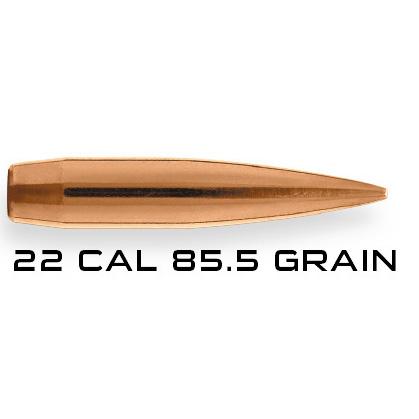
Berger built the 85.5 grain Long Range Hybrid Target bullet to do something people used to think a .22 caliber couldn't: stay stable and competitive all the way out to 1,000 yards. These are .224 diameter match projectiles meant for handloaders who run fast-twist rifles and want to squeeze every bit of ballistic performance out of their loads. With a G1 BC of 0.524 and a G7 of 0.268, this one punches well above its weight class in the wind.
What Makes the 85.5 gr Long Range Hybrid Target Tick
The heart of this bullet is Berger's Meplat Reduction Technology, which applies controlled pressure along the nose during manufacturing to create a uniform, repeatable profile from bullet to bullet. That matters because consistent BCs mean less vertical dispersion and less wind drift downrange. Berger's ballistic coefficients are Doppler radar verified, so the numbers you load around are the numbers you'll see on target. The hybrid ogive blends a tangent nose section for forgiving seating depth with a secant section to cut drag, which is why so many reloaders find this bullet tunes without a lot of fuss.
Twist Rate and Cartridges for the .22 Cal 85.5 Grain LRHT
Berger lists a minimum 1:8 twist for this bullet, though plenty of folks running it hard prefer a 1:7 or 1:7.5 to keep stability factors comfortable, especially at lower altitudes or in cooler weather. It's a natural fit for cartridges like the .22 Creedmoor, .224 Valkyrie, 22-250, .22 ARC, and fast-twist .223/5.56 rifles. The J4 Target Jacket holds an impressive concentricity tolerance, and that precision is a big part of why this bullet has earned a following among Palma and long-range target competitors.
Keep in mind these are component bullets only, not loaded ammunition. You'll be supplying your own brass, primers, and powder to build a finished round. For anyone serious about stretching a .22 bore to distances that used to belong to the 6mm and 6.5mm crowd, this is one of the top projectiles on the market.
Key Specifications
- Manufacturer: Berger Bullets
- Manufacturer Part Number: 22785
- UPC: 679459227858
- Caliber: .22 Caliber (0.224")
- Bullet Weight: 85.5 Grain
- Product Line: Long Range Hybrid Target
- Bullet Style: Hollow Point Boat Tail
- Ogive Style: LR Hybrid
- Jacket: J4 Target Jacket
- Ballistic Coefficient G1: 0.524
- Ballistic Coefficient G7: 0.268
- Sectional Density: 0.243
- Minimum Twist Rate: 1:8"
- Quantity: 1000 Count
What’s Included
- 1000 Berger .22 Caliber 85.5 grain Long Range Hybrid Target bullets (projectiles only)
Frequently Asked Questions
What twist rate do I need for the Berger 85.5 gr Long Range Hybrid Target?
Berger lists a minimum 1:8 twist for this bullet. Many reloaders running it at lower altitudes, in cooler temperatures, or pushing for maximum stability lean toward a 1:7 or 1:7.5 twist to keep their stability factor comfortable. Running the numbers through Berger's twist rate stability calculator is a smart move before you commit to a load.
Which cartridges work well with the .22 Cal 85.5 grain Long Range Hybrid Target?
This bullet shines in fast-twist .22 caliber cartridges built for distance, including the .22 Creedmoor, .224 Valkyrie, 22-250 Remington, .22 ARC, and fast-twist .223/5.56 rifles. It's a popular choice among long-range and Palma competitors looking to reach 1,000 yards with a .22 bore. Just make sure your barrel twist can stabilize the 85.5 grain weight.
Are these Berger bullets loaded ammunition or components?
These are component bullets only, meaning projectiles by themselves. You'll need to supply your own brass, primers, and powder and handload them into finished cartridges. They are not ready-to-fire ammunition.
What makes the Long Range Hybrid Target design better for wind?
The hybrid ogive combines a tangent section for easy, forgiving seating depth with a secant section that reduces drag. Combined with Berger's Meplat Reduction Technology, which creates a repeatable nose profile, you get consistent, Doppler-verified ballistic coefficients. That consistency translates directly into less wind drift and tighter vertical dispersion at long range.





Reviews
There are no reviews yet.