Description
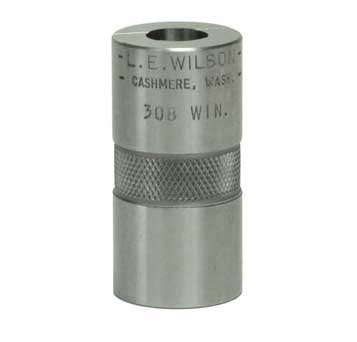
If you're loading for the .300 Remington Ultra Magnum, this little steel block earns its place on the bench fast. The L.E. Wilson Case Gage is a one-piece, non-adjustable tool that lets you check two things that matter most when prepping bottleneck brass: the head-to-datum length (your headspace) and overall case length for trimming. You drop a case in, compare where it sits against the machined steps, and you know whether your brass is good to go or needs attention. No calipers required for a quick pass, though you can get more precise with a depth micrometer if you want numbers.
What makes these gages trustworthy is how they're cut. Rather than using a chambering reamer, Wilson machines them with special reamers that leave extra clearance in front of and behind the shoulder, so the case only contacts the gage at the actual gaging point. That means you're reading the shoulder datum and nothing else throwing off your measurement. The design goes all the way back to 1935, when founder Sam Wilson built the first one to help a fellow reloader chase down a case-separation problem, and the concept has held up ever since.
Dialing In Your .300 RUM Sizing Die
The real value here is setting shoulder bump. The smart move is to measure a case in as-fired condition, note where it sits, then resize and check again. On a bolt gun you're generally looking to push the shoulder back around .002 inches, a touch more for semi-autos. Getting that bump right keeps your brass alive longer and keeps pressure and chamber fit consistent round to round.
Checking Trim Length on the 300 Ultra Mag Case Gage
For trim checks, set the case head on a flat surface, slide the gage over the top, and run a straight edge across the max and min steps. If the case mouth catches the straight edge at the max step, it's time to trim. One thing worth knowing up front: this gage reads head-to-datum and case length only. It does not measure body or neck diameters, so it's not a full ammo pass/fail gage for those dimensions. For headspace and trim length on your .300 RUM brass, it's about as straightforward and repeatable as it gets.
Key Specifications
- Manufacturer: L.E. Wilson
- Manufacturer Part Number: CG-ULMG
- UPC: 857949005616
- Cartridge: .300 Remington Ultra Magnum
- Type: Case Gage
- Design: One-piece, non-adjustable
- Material: Steel
- Measures: Head-to-datum (headspace) and overall case length
- Country of Origin: United States
What’s Included
- L.E. Wilson 300 Remington Ultra Magnum Case Gage (CG-ULMG)
Frequently Asked Questions
What does the 300 RUM Case Gage actually measure?
It checks two things: the head-to-datum length, which is your headspace, and the overall case length for trimming. You compare where the case sits against the machined min and max steps on the gage. It does not measure body or neck diameters, so keep that in mind if you're trying to gage a full loaded round.
Do I need a depth micrometer to use the Wilson Case Gage?
No, you can get a solid pass or fail reading just by using a straight edge across the min and max steps. That said, if you want precise numbers for tracking exactly how much you're bumping the shoulder, the Wilson Case Gage Depth Micrometer pairs with it nicely. For most bench work, the quick visual check is plenty.
Should I use fired or resized brass with this gage?
Both, and that's the point. Measure a case in as-fired condition first to get a baseline from your rifle's chamber, then resize and check again to see how much your die is setting the shoulder back. For a bolt gun you're usually aiming for about .002 inches of bump, slightly more for semi-autos.
Will this gage work for other cartridges like .338 RUM or .375 RUM?
No, this one is cut specifically for the .300 Remington Ultra Magnum. Even though those other Ultra Mag cartridges share a parent case, their dimensions differ, so you'd want the gage made for each chambering. Wilson offers a dedicated gage for most popular rimless cases.





Reviews
There are no reviews yet.