Description
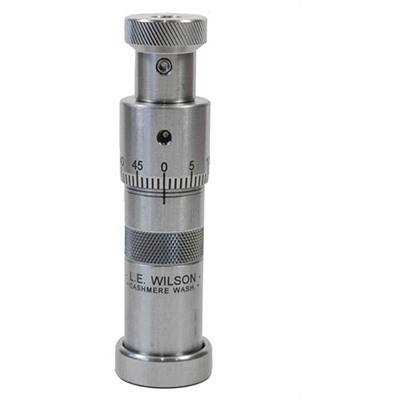
L.E. Wilson built this 6mm BRX seater around one simple idea: hold the bullet and case in perfect alignment before anything moves. Instead of relying on a sliding collar or loose body like a conventional die, the chamber-type design fully captures the case and bullet inside a precisely machined cavity, then pushes the bullet straight down with a close-fitting stem. That stationary-case approach is exactly why these dies have such a loyal following among reloaders chasing minimal runout and tight concentricity.
The micrometer top is where you'll spend your time. The scale is graduated in .001-inch increments, so adjusting seating depth is a matter of turning the dial and reading the number, no trial-and-error with lock rings. Major adjustments get handled through the 3/8-inch to 24 TPI threads in the cap, while the micrometer handles the fine-tuning. A lot of folks keep one of these in their range bag specifically for load development, setting the micrometer at the land-touch mark and testing seating depths right between strings.
How the 6mm BRX Seater Fits Your Setup
This is a hand die, not a press die. It runs on an arbor press, and you can even seat with a soft-faced mallet in a pinch, but it is not made for a conventional threaded press. Wilson recommends the K&M Precision arbor press, which was designed with these seaters in mind, though it plays nicely with any quality arbor setup. The real draw is the feel: you can sense neck tension through the whole seating stroke, which tells you a lot about your brass prep and annealing.
Build and Stem Details
The die is machined from long-lasting stainless steel with laser-engraved caliber marking, so it'll hold up through thousands of rounds without complaint. It ships with the standard seating stem, which covers most conventional and tangent-ogive bullets. If you're running VLD or secant-profile projectiles, a separate VLD stem is available to match that bullet nose better. For the 6mm BRX crowd running tight competition loads, this is about as repeatable as seating gets.
Key Specifications
- Manufacturer: L.E. Wilson
- Manufacturer Part Number: S6M-BRX
- UPC: 815145027634
- Caliber: 6mm BRX
- Die Type: Chamber-Type Micrometer Top Bullet Seater
- Material: Stainless Steel
- Micrometer Graduations: .001-inch increments
- Cap Threading: 3/8" – 24 TPI
- Press Compatibility: Arbor press (or soft-faced mallet)
- Seating Stem: Standard stem included
- Marking: Laser engraved
- Country of Origin: United States
What’s Included
- 6mm BRX micrometer top bullet seater die body
- Seater base
- Standard seating stem
Frequently Asked Questions
Can I use the 6mm BRX seater die in my regular reloading press?
No, this is a chamber-type hand die made for use on an arbor press. You can also seat bullets with a soft-faced mallet if needed, but it will not thread into a conventional 7/8-inch to 14 press. If you don't already have an arbor press, Wilson recommends the K&M Precision press designed with these dies in mind.
What does the micrometer top actually do?
It lets you adjust seating depth in precise .001-inch increments just by turning the dial, with an easy-to-read scale. Major depth changes are made through the 3/8-inch to 24 TPI threads in the cap, and the micrometer handles the fine adjustments. Many reloaders set it at their land-touch mark and use it for seating-depth testing during load development.
Does this die come with a VLD seating stem?
It ships with the standard seating stem, which works well with most conventional and tangent-ogive bullets. If you're loading VLD or secant-profile projectiles, a separate VLD stem is available that better matches those bullet noses. Swapping stems is simple if you decide you need the VLD version down the road.
Why choose a chamber-type seater over a conventional seating die?
The chamber-type design fully captures both the case and bullet and holds them in alignment before the bullet is pressed straight into the case. That reduces the slop and misalignment that can creep into looser conventional dies, which is why these are a favorite for benchrest and precision long-range work. The payoff is lower runout and more consistent concentricity on your finished rounds.




Reviews
There are no reviews yet.