Description
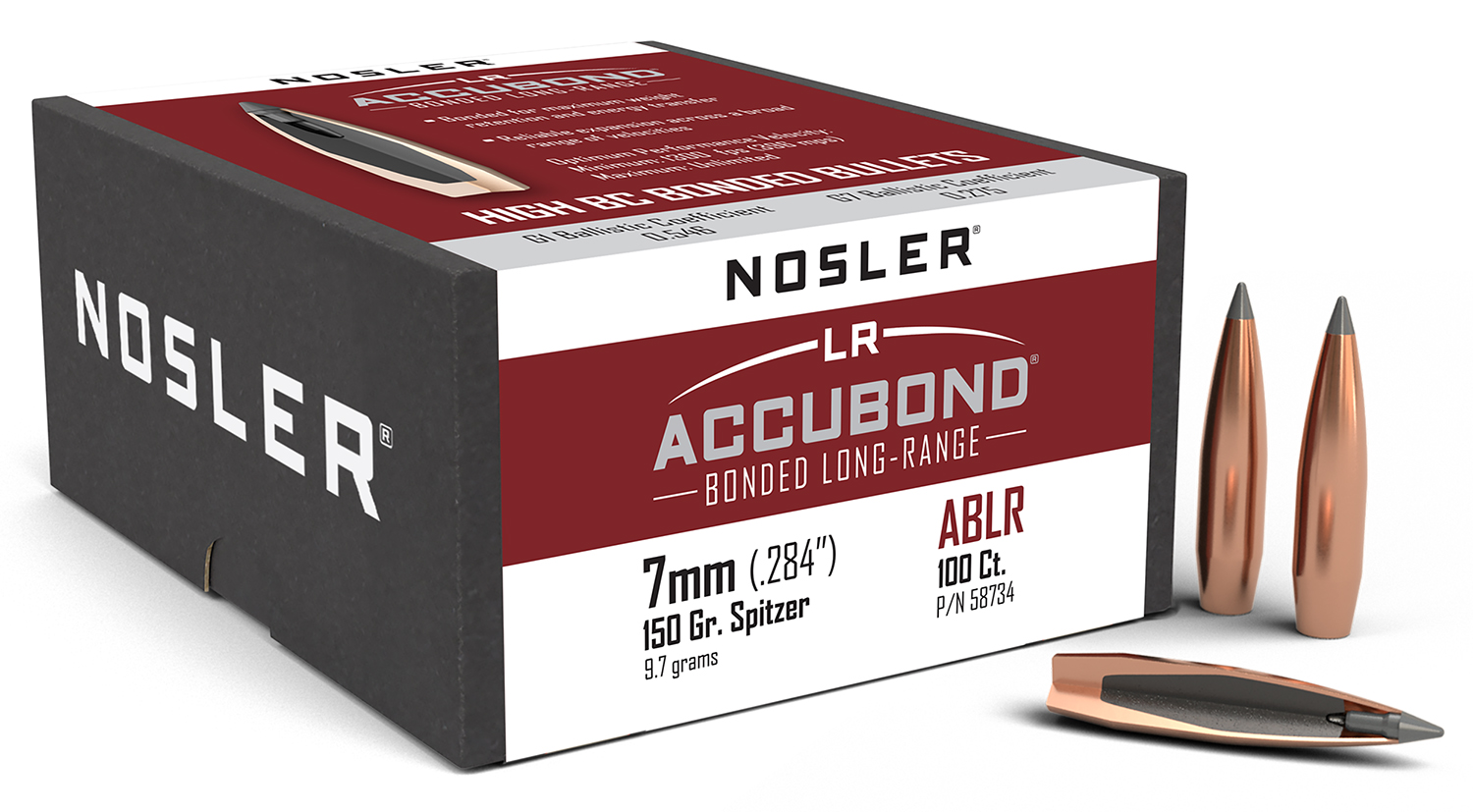
The Nosler AccuBond Long Range 7mm bullet came about because long-range hunters kept asking for a projectile that could keep pace with ultra-fast 7mm cartridges and high-grade optics while still putting game down cleanly at serious distances. This .284 diameter, 150-grain spitzer boat tail is Nosler's answer, and it threads the needle between flat-shooting aerodynamics and the bonded toughness you want when the range stretches out. Nosler lists the G1 ballistic coefficient at 0.546 and the G7 at 0.275, and they recommend running the G7 number when you're building trajectory data for the ABLR line.
What Sets the AccuBond LR 7mm 150gr Apart
The whole design leans on a tapered copper-alloy jacket bonded to a lead-alloy core. That bond is the heart of the bullet, keeping the core and jacket locked together so you get strong weight retention and deep penetration instead of coming apart at high impact speeds. The gray polymer tip resists deformation under recoil, feeds smoothly, and kicks off reliable expansion downrange. A tangent ogive and the sleek boat-tail base round things out for consistent seating depth and a cleaner ride through the air.
Why Reloaders Reach for This 7mm Bullet
What really separates the AccuBond LR from a standard hunting bullet is its expansion window. Nosler engineered it to open up reliably down to 1,300 fps of impact velocity, compared to the 1,800 fps minimum on their other hunting bullets. That lower threshold is exactly what lets it perform way out past where most bullets quit, while the bonded construction means it still behaves at the high velocities of cartridges like the 7mm Rem Mag, 7mm PRC, 28 Nosler, and 7mm STW.
Loading the AccuBond Long Range 7mm
This 150-grain weight is a sweet spot for a lot of 7mm rifles, giving you a flat trajectory without the recoil of the heaviest options. Nosler's ballisticians have found that seating these to the maximum SAAMI cartridge overall length tends to produce the best accuracy, so that's a good starting point when you work up a load. With a sectional density of .266, you're getting the penetration to back up the aerodynamics on medium and larger big game.
Key Specifications
- Manufacturer: Nosler
- Manufacturer Part Number: 58734
- UPC: 054041587341
- Bullet Caliber: 7mm
- Bullet Diameter: .284
- Bullet Weight: 150 grain
- Bullet Type: AccuBond Long Range
- Bullet Profile: Spitzer
- Bullet Base: Boat Tail
- Tip Material: Polymer
- Jacket Material: Tapered Copper Alloy
- Core Material: Bonded Lead Alloy
- Ballistic Coefficient (G1): 0.546
- Ballistic Coefficient (G7): 0.275
- Sectional Density: .266
- Cannelure: No
What’s Included
- 100 Nosler AccuBond Long Range 7mm (.284) 150gr reloading bullets
Frequently Asked Questions
What makes the AccuBond LR different from a standard AccuBond?
The AccuBond Long Range is tuned specifically for extended-distance performance. It carries a higher ballistic coefficient and a longer ogive, and it's engineered to expand reliably at impact velocities as low as 1,300 fps, versus the 1,800 fps minimum on Nosler's standard hunting bullets. That lower expansion threshold is what lets it keep working well past 1,000 yards.
Which 7mm cartridges work with the Nosler AccuBond LR 150gr?
This .284 diameter bullet is suited to the full range of 7mm cartridges. That includes popular options like the 7mm Rem Mag, 7mm PRC, 28 Nosler, 7mm-08 Rem, 7mm SAUM, and 7mm STW. It's a versatile pick whether you're shooting a standard magnum or one of the newer high-velocity 7mm rounds.
Should I use the G1 or G7 ballistic coefficient for this bullet?
Nosler recommends using the G7 ballistic coefficient when calculating trajectories for the AccuBond Long Range line. For this 150-grain 7mm, that figure is 0.275, while the G1 is 0.546. The G7 model more closely matches the bullet's boat-tail shape, so your drop and drift numbers will track better in the real world.
What's a good starting point for seating depth with these bullets?
Nosler's ballisticians have found that loading the AccuBond LR to the maximum SAAMI cartridge overall length tends to deliver the best accuracy. That's a solid place to begin your load development before fine-tuning for your specific rifle. Always work up your charge from published data and watch for pressure signs as you go.





Reviews
There are no reviews yet.