Description
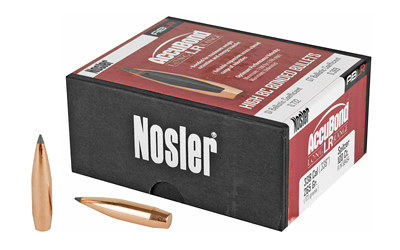
Nosler built the AccuBond Long Range line for hunters who wanted a bonded bullet that could keep pace with modern high-velocity cartridges and today's long-range optics without giving up terminal performance on game. The .338 caliber, 265 grain version is the heavyweight of the bunch, pairing a sleek boat-tail profile and long ogive with a G1 ballistic coefficient of 0.732 and a sectional density of 0.331. That combination lets it buck wind and hold onto energy well past 1,000 yards, which is exactly where this bullet earns its keep.
What Sets the .338 AccuBond Long Range Apart
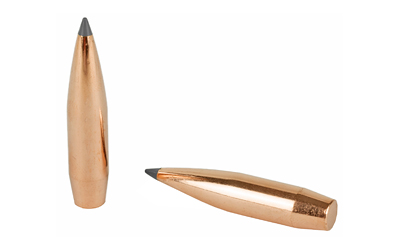
The heart of this bullet is Nosler's proprietary bonding process, which fuses the lead core to the tapered copper jacket. That jacket runs thin at the nose and thickens toward the base, so you get rapid expansion for clean energy transfer up front while the heavier rear section drives deep penetration. Because the core and jacket are bonded, the ABLR holds together at high impact velocities and retains a big chunk of its weight, so you're not chasing fragments through an animal.
Dialing In the ABLR 265 Grain for Long Shots
One of the standout traits here is the low minimum expansion velocity. Where most Nosler hunting bullets want around 1,800 fps on impact, the AccuBond Long Range is designed to open up at velocities as low as 1,300 fps. That stretches your effective range considerably and keeps the bullet working when a shot reaches way out there. Nosler recommends using the G7 ballistic coefficient of 0.369 when you're building drop charts for this line, since it gives a more accurate trajectory for these long, low-drag projectiles.
Loading the .338 AccuBond Long Range
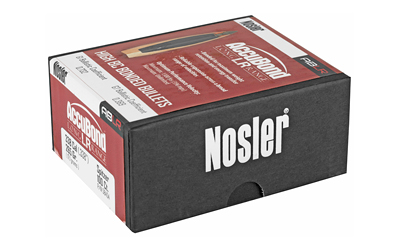
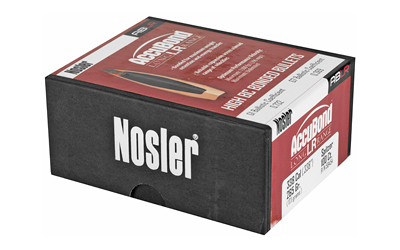
These are projectiles only, sold for handloading, with a 1.700 inch overall length and no cannelure. The long, sleek ogive means you don't have to seat them hard against the lands to shoot well, which gives you flexibility across different .338 chamberings like the .338 Lapua Magnum, .33 Nosler, .338 Win Mag, and .338-06. Made in the USA and sold 100 to the box, they're a solid pick for elk, moose, and big game hunters who want reach and reliable expansion in one bullet.
Key Specifications
- Manufacturer: Nosler
- Model: AccuBond Long Range (ABLR)
- Manufacturer Part Number: 58454
- UPC: 054041584548
- Caliber: .338 Caliber
- Bullet Diameter: 0.338 in
- Grain Weight: 265 gr
- Bullet Profile: Spitzer Boat Tail
- Bullet Tip Material: Polymer
- Jacket / Core: Bonded Copper Jacket, Lead Core
- Ballistic Coefficient (G1): 0.732
- Ballistic Coefficient (G7): 0.369
- Sectional Density: 0.331
- Overall Length: 1.700 in
- Cannelure: No
- Quantity: 100 Per Box
What’s Included
- 100 Nosler AccuBond Long Range .338 caliber 265 grain bullets (projectiles only, for handloading)
Frequently Asked Questions
What is the ballistic coefficient of the .338 AccuBond Long Range 265 grain?
This bullet carries a G1 ballistic coefficient of 0.732 and a G7 of 0.369, with a sectional density of 0.331. Nosler recommends using the G7 number when building trajectory charts for the ABLR line, as it gives a more accurate drop solution for these long, low-drag bullets. Those figures put it among the flatter-shooting, more wind-resistant .338 options out there.
At what velocity will the AccuBond Long Range reliably expand?
Nosler designed the ABLR with a minimum impact velocity of 1,300 fps for reliable expansion, which is lower than the roughly 1,800 fps most of their other hunting bullets need. That lower threshold is what makes it suited to long-range shots where the bullet has shed a lot of speed by the time it arrives. On the top end, the maximum velocity is unlimited thanks to the bonded construction.
Are these loaded ammunition or just bullets for reloading?
These are component bullets only, meaning projectiles for handloading your own cartridges. They come 100 to a box and are not loaded ammo. You'll need your own brass, powder, and primers to assemble finished rounds.
What cartridges can I load the .338 265 grain ABLR in?
Any .338 caliber cartridge that can stabilize a heavy 265 grain bullet is a candidate, including the .338 Lapua Magnum, .33 Nosler, .338 Winchester Magnum, .340 Weatherby, and .338-06. Published load data covers a wide range of .338 chamberings. The long ogive shoots well without being seated hard against the lands, which adds some flexibility across different rifles.




Reviews
There are no reviews yet.